
Companies Cut People Before the AI Can Do the Work: The Real AI Risk Isn't That It Takes Jobs
55% of companies that laid off staff for AI already regret it. Two in three are rehiring. The mistake was never the technology. It was the order of operations.

Why Companies Regret Firing Staff For AI (Audio overview by NLM)
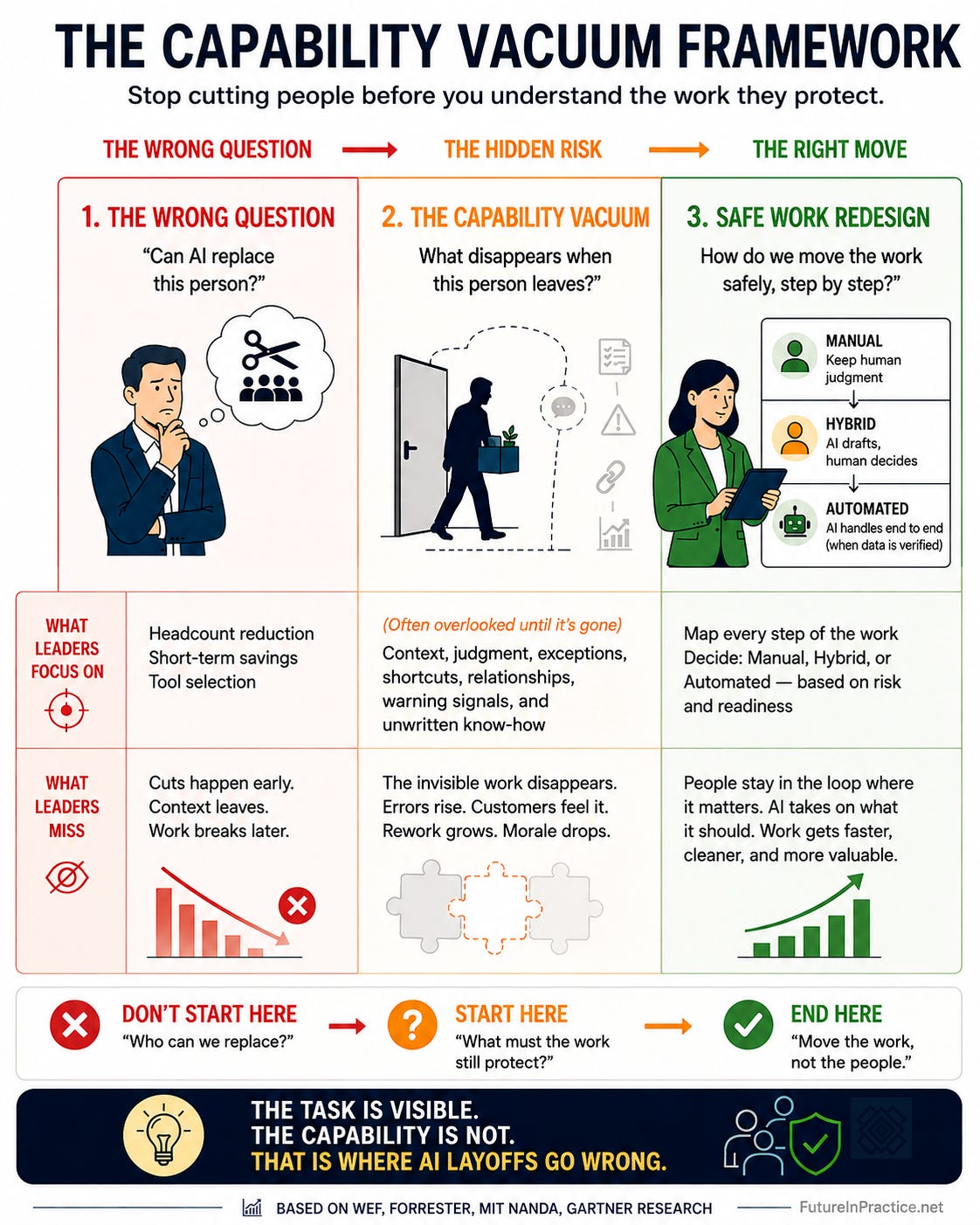
The fear is everywhere: AI is coming for the jobs. The data tells a more useful story – it changes who should actually be worried and why. The companies in trouble are the ones that cut people before the AI could do the work, but not the ones that adopted AI.
This is a story about what companies don’t know about how their own work gets done. It’s not a story about technology.
In this article:
The job-loss panic runs against the numbers. The World Economic Forum projects a net gain of 78 million jobs by 2030. The real risk is internal: companies cutting people before their AI can do what those people did.
55% of executives who cut staff for AI already regret it, and two in three companies are rehiring within six months. The technology worked. The sequencing didn’t.
Removing an experienced person doesn’t just remove their tasks. It removes everything they did that nobody wrote down. That gap has a name: the Capability Vacuum.
Pilots don’t fail because the models are weak. They fail because they start from “which tool?” instead of “what must this work achieve, and who understands it best?”
A simple map of every workflow step, manual, hybrid, or automated, each with its own risk and benefit, tells you which parts of your work are ready for AI and which aren’t.
The evidence is sharper than the headlines suggest. Here is what the data actually says, placed against what the panic says.
The panic blames the technology. The evidence blames the companies.
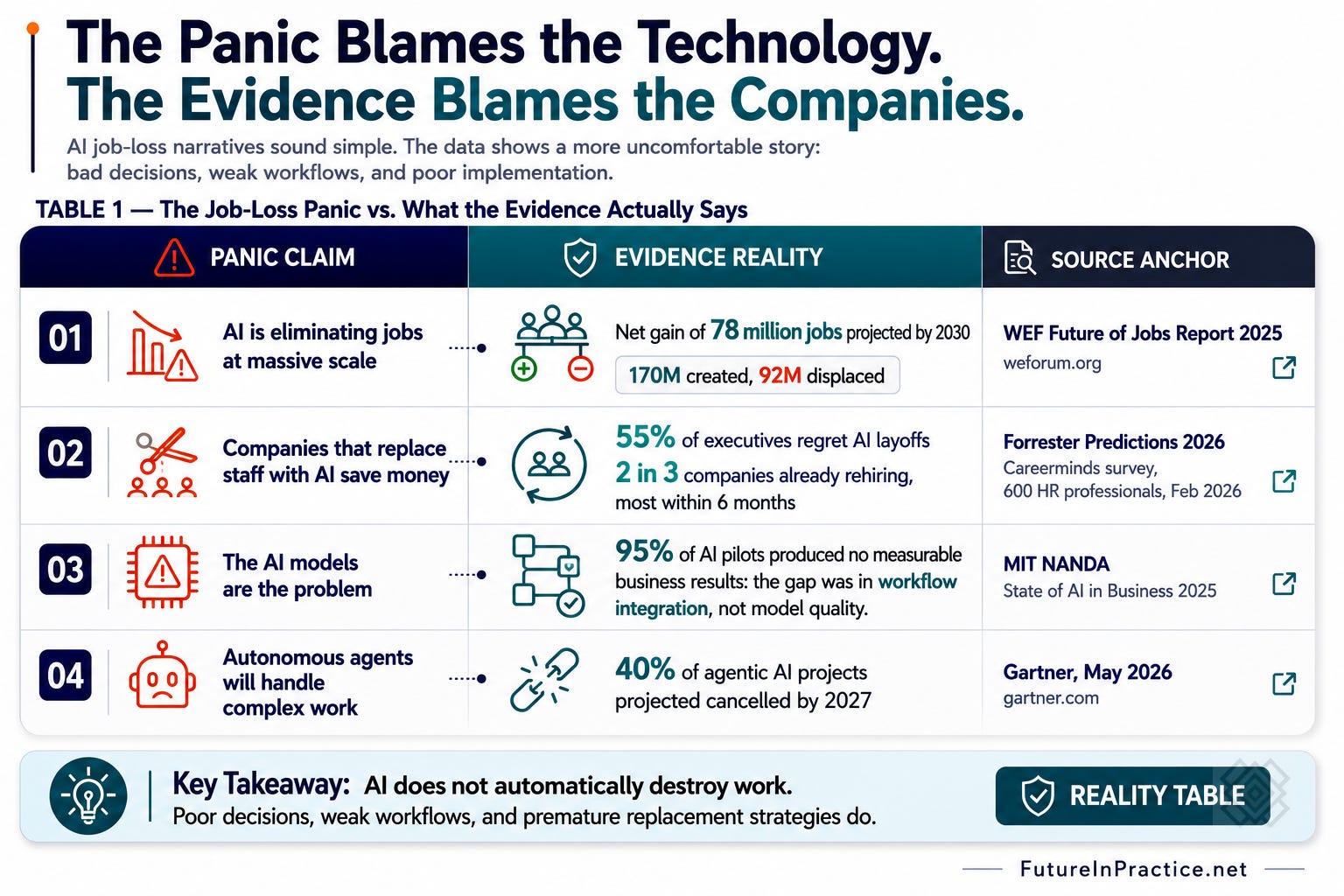
Companies are cutting people before their AI systems can do what those people actually did.
I keep seeing two versions of the same company. One automates first and regrets it. One maps the work first and compounds.
The Capability Vacuum
When you remove an experienced person, you don’t just remove their tasks. You remove everything they did that nobody wrote down. The part of the job nobody documented, nobody trained for, and nobody noticed until it stopped happening. That gap is the Capability Vacuum.
Here is what it looks like in practice.
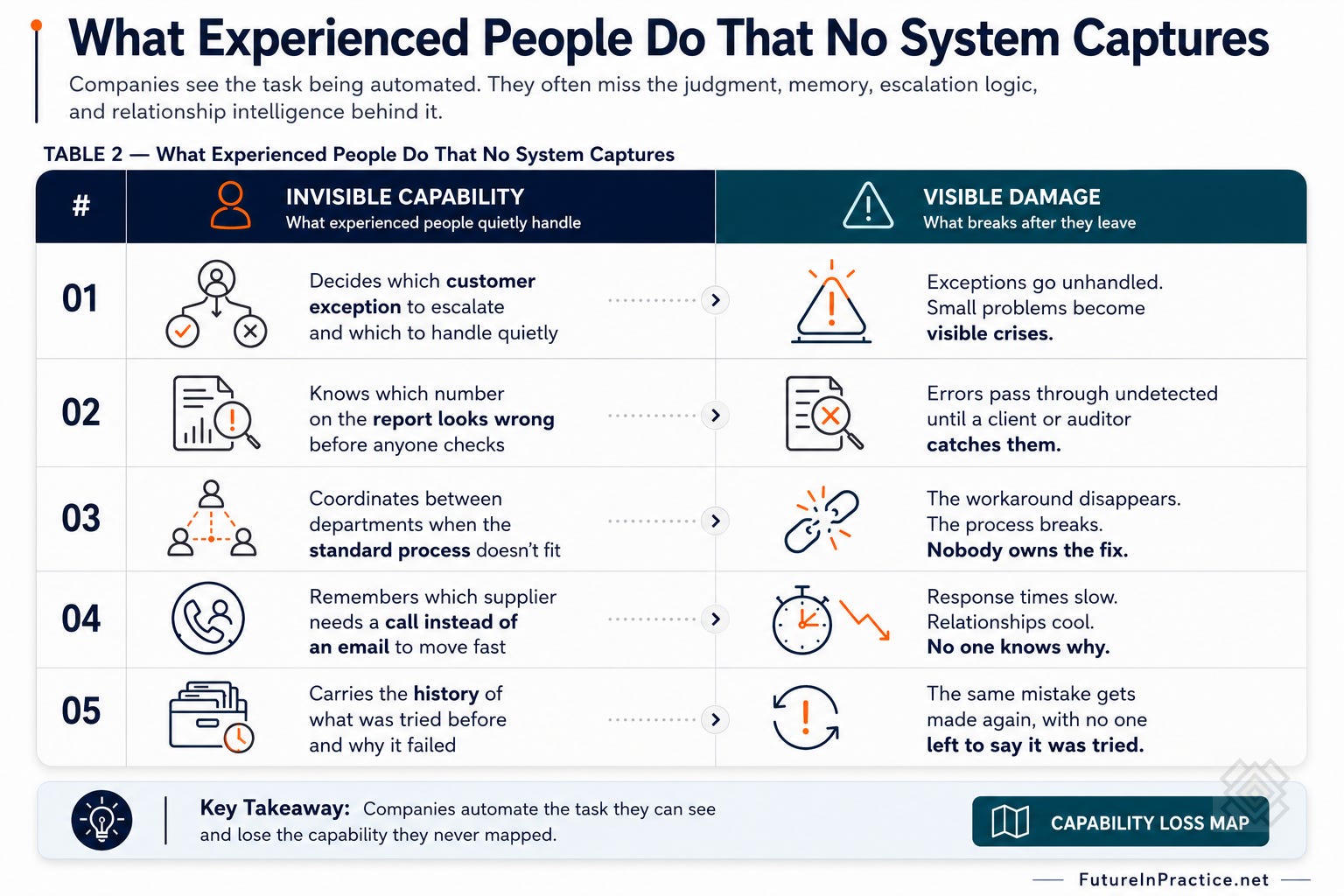
The task is visible. The capability is not. That is where AI layoffs go wrong.
Every company has rows like these. If you can’t name yours, you are not ready to automate.
Where the error starts
A telecom company in the Balkans showed me this up close. The owner is sharp, not a programmer. He had built working AI agent prototypes himself, using no-code tools. Real, functioning automations. The employees never picked them up.
Not because the tools were bad. Because the project started from the tools: which AI model to use, which way to build an agent, which platform to connect. It never started from the question the employees lived inside every day: what does this work need to do, and where is it safe to change it?
That is the whole error in one line:
You cannot automate what you haven’t understood. Cuts happen early. Context leaves. Work breaks later.
The reframe that unlocked it
We never talked about AI replacing anyone. It is a design decision.
The people in that company were too valuable to remove. Their contextual knowledge of the work, the exceptions, the client and partner relationships, the judgement calls, was the actual asset. An AI model can hold general knowledge. It cannot hold the context that only comes from doing the work. So the question became: how does AI assist them?
The moment employees saw the tools as support for their judgement instead of a threat to their position, they engaged. From there, the work became a map.
We went through the workflow and classified each part by its risk and its readiness.
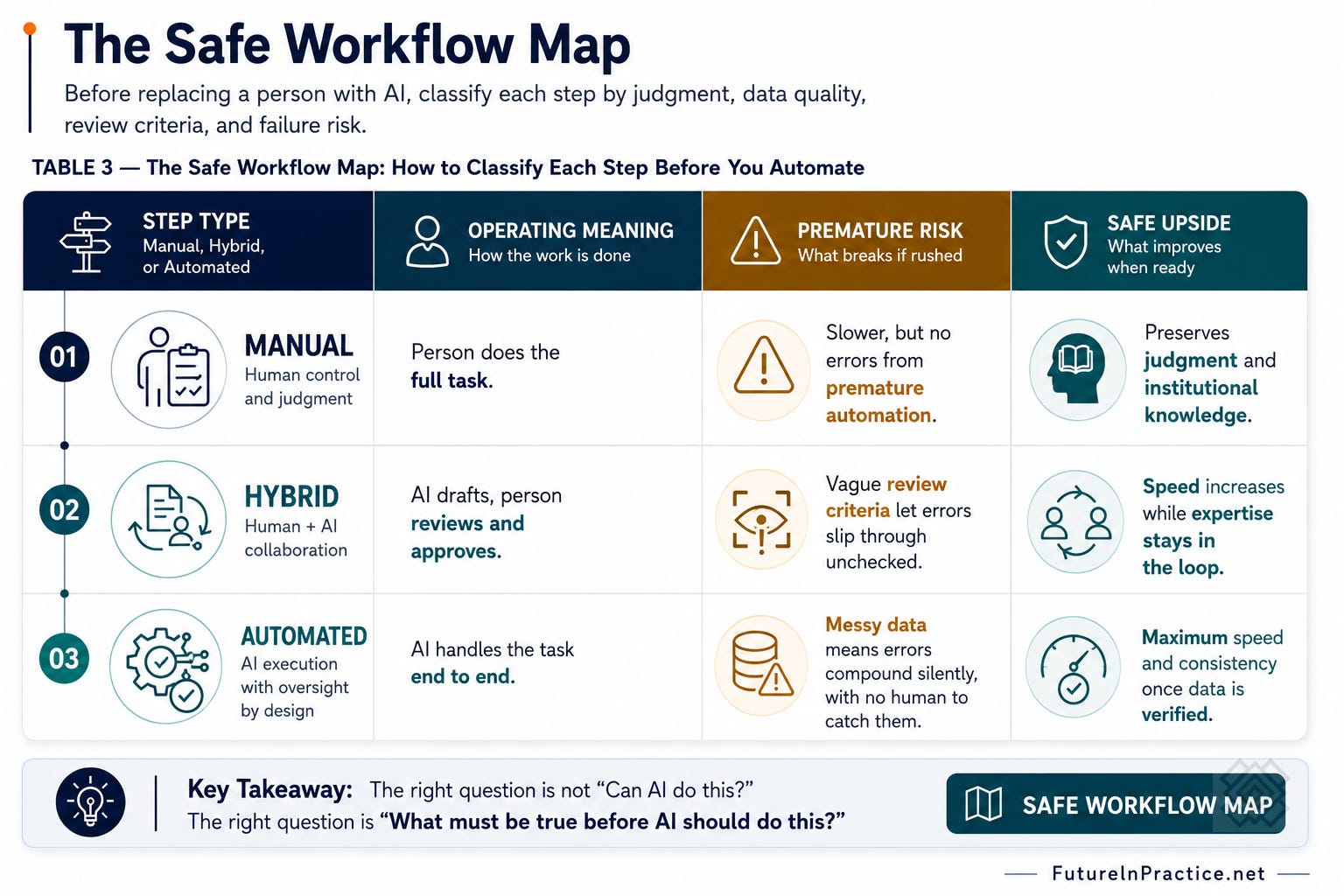
What should you do:
Walk your own workflow through these three rows.
For each step, name the risk and the benefit.
If you can’t place a step clearly, it is not ready to move.
The telecom company asked the second question. The pilot launched. The people stayed. The workflow compounds, one safe step at a time.
IKEA ran a larger version of the same principle: automated half its customer calls, kept all 8,500 workers, retrained them as design advisers. It became one of IKEA’s fastest-growing revenue streams.
PwC’s 2025 Global AI Jobs Barometer, drawn from nearly a billion job postings (pwc.com), found that industries most exposed to AI grow revenue per employee three times faster. Not by firing. By making people harder to replace.
Three questions before your next AI project
They take five minutes and tell you which side of the data you are on.
Can you describe what the process must achieve in one sentence, without naming a single tool?
If not, you are starting from tools, not intent.Can you name what your most experienced person does that no system captures?
That is your Capability Vacuum. It opens the moment they leave.For each step in the workflow, can you say whether it stays manual, goes hybrid, or gets automated, and why?
If you can’t, you don’t have a pilot. You have a hope.
The panic says AI will take the work. The evidence says the work is changing hands, not disappearing.
The companies that win the next two years are not the ones that cut fastest. They are the ones who kept the people who understood the work, and moved the work, not the people.
Resources
World Economic Forum — Future of Jobs Report 2025
Forrester — Predictions 2026: The Future of Work
Careerminds — AI-Led Layoffs Survey, 600 HR Professionals
MIT NANDA Initiative — State of AI in Business 2025: The GenAI Divide