
Guide to 2030: From Digital Efficiency to Compounding Value
Top 30 most important and profitable skills by 2030 – and how they accelerate business performance

Business in 2030 will be shaped by skills currently held by less than 10% of the workforce — and those skills will determine who moves forward and who stays locked in old ways of working.
The biggest changes do not come from technology itself, but from how people develop and which skills become the new foundation of business value.
INTRODUCTION
This document provides a clear, practical framework for understanding the new business roles, the skills that carry the highest value, and how they guide stable and secure organizational growth in the period 2025–2030.
It synthesizes the most relevant research (the list is at the end of this article) and real-world practice into a ranking of 30 key skills — based on the value they bring to an organization and how rarely they are developed and applied in day-to-day work.
At the intersection of these two criteria sits distilled the Top 10 skills that become the foundation for any modern organization.
This framework simplifies decision-making and provides a clear direction for preparing systems, processes, and people for doing business in 2030.
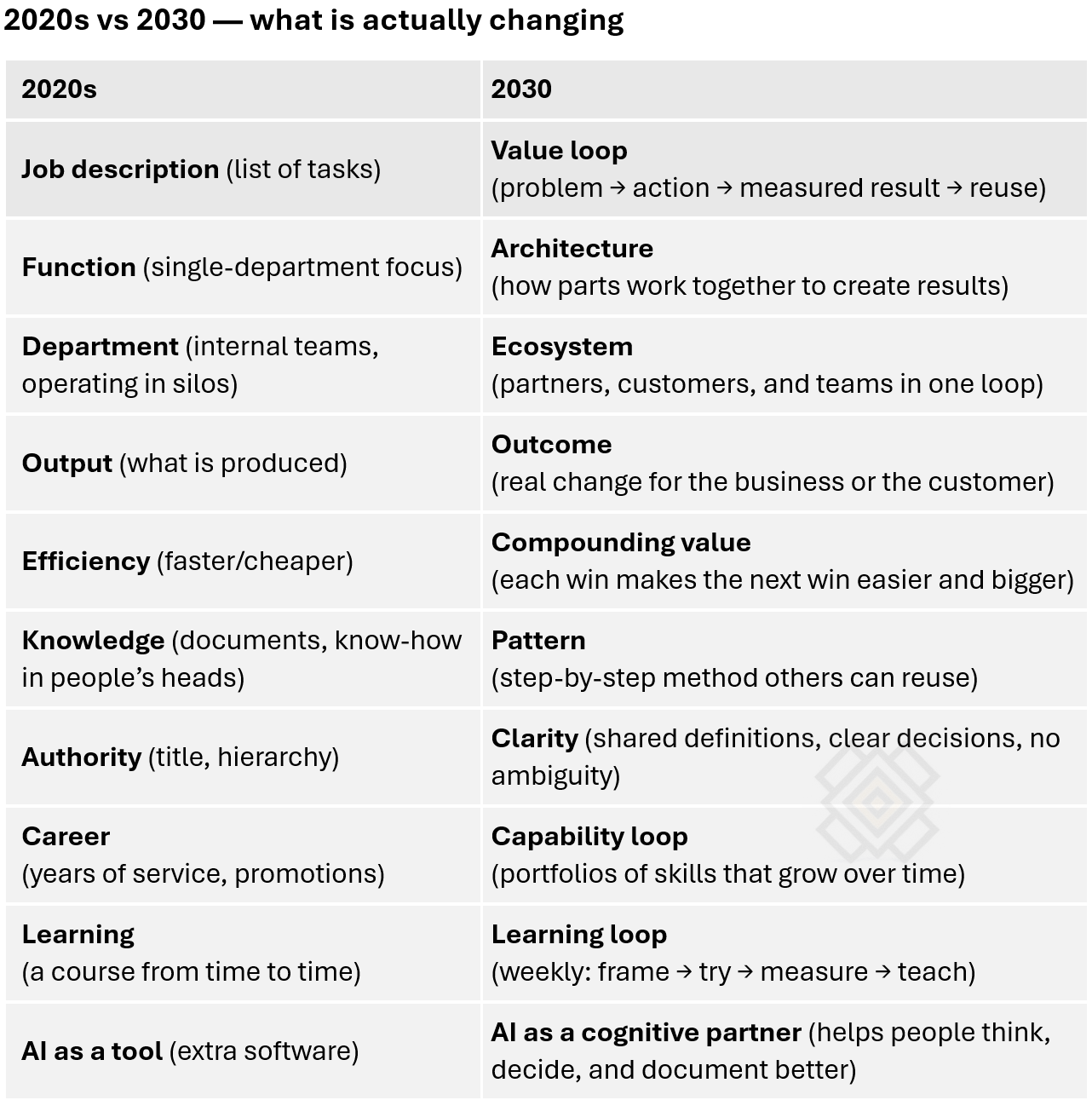
The Core Business Shift 2020s → 2030 in the Age of AI
This is the simplest possible overview of the difference between today’s logic of work and the logic that shapes 2030 — a shift from organizations focused on tasks to organizations that create outcomes, systems, and compounding value.
Why this matters now
After a long period of uncertainty, five-year planning (2025–2030) once again makes sense.
The reason: the integration of artificial intelligence (AI) changes the role of technology in organizations — not as “a tool that speeds things up”, but as “an operating system that enables new ways of working.”
Change now happens differently:
AI enables much earlier detection of trends (12–18 months ahead)
Strategies can be adjusted faster — in weeks or months, not in years
What remains stable is the purpose of work — human needs, ethics, and the value logic of the organization
Result: Organizations that have a clearly defined vision for 2025–2030 and treat AI as a system, not just as a tool, gain a significant structural advantage.
Looking toward 2030
By 2030, the organizations that endure will not be those with the most technology, but those that best integrate technology with human skills inside a long-term strategy.
This requires an approach built on three levels of architecture — each level builds on the previous one.
Three levels of organizational maturity (2025 → 2030)
Illustration: What sets successful organizations apart by 2030?
This is the clearest overview of three essential levels of transformation — from the first step to systems that generate compounding value.
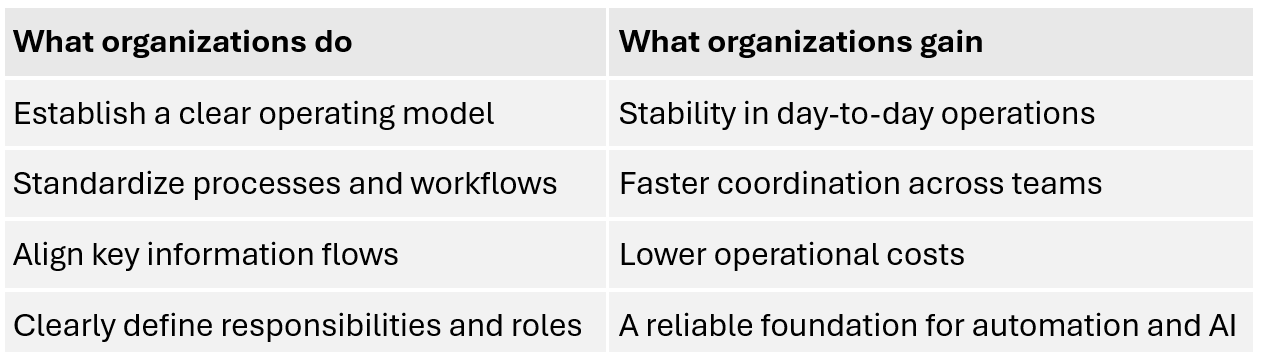
LEVEL 1: STRUCTURE
Level 1 shows how an organization creates a stable foundation: it removes chaos, sets clear rules of work, and builds a structure that enables efficiency and further development.
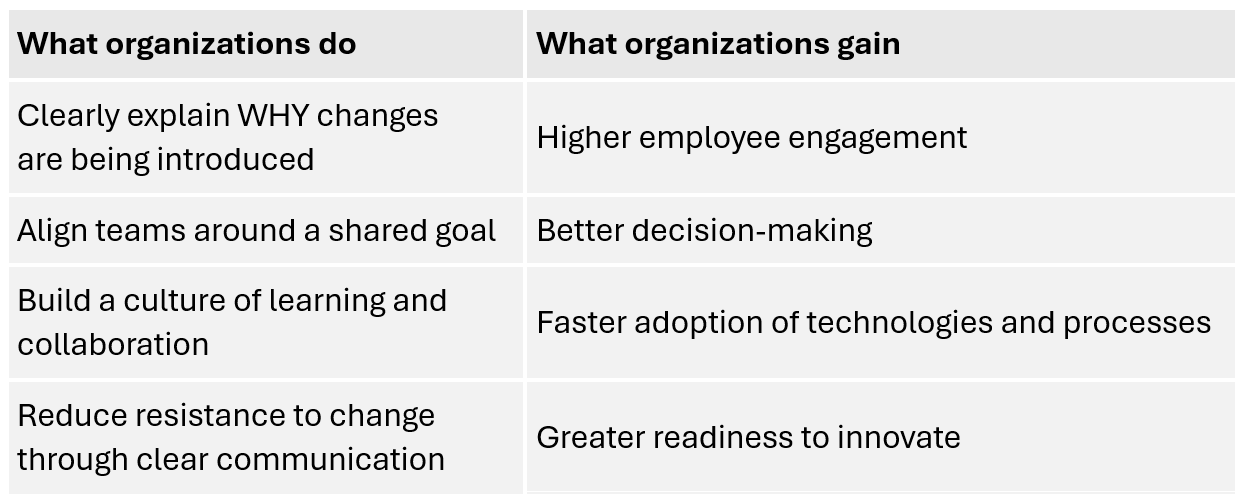
LEVEL 2: PURPOSE
Level 2 shows how an organization moves from “what we do” to “why we do it” — through purpose, alignment, and a learning culture that ensures changes actually turn into everyday practice.
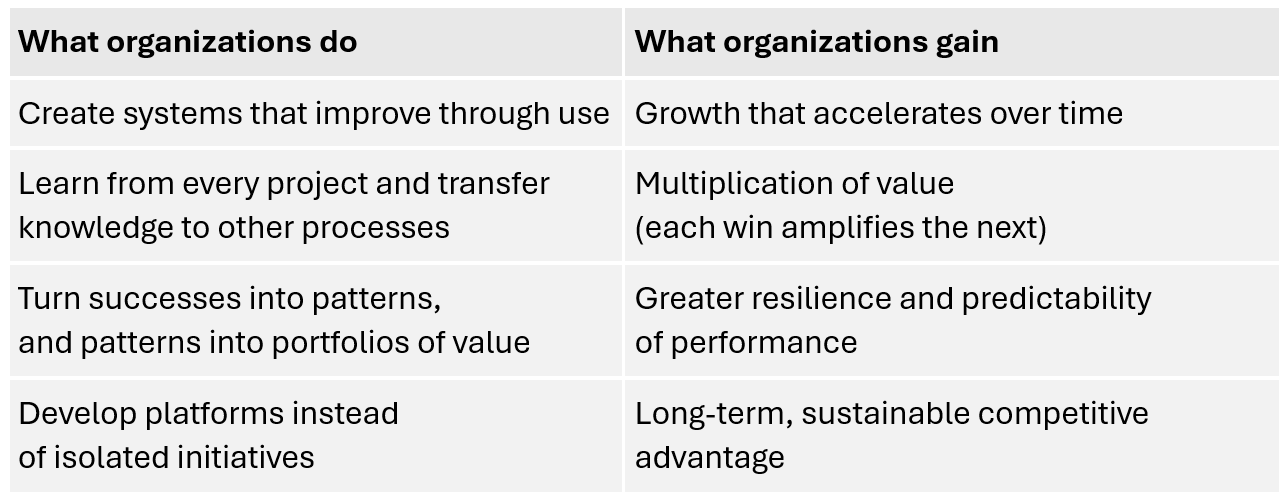
LEVEL 3: COMPOUNDING VALUE
Level 3 presents the highest stage of development: the organization not only performs well but creates systems that improve themselves over time and generate ever-increasing value.
Successful organizations by 2030 are not the ones using the most tools — they are the ones that build clear structure (Level 1 – Clarity), explain and live purpose (Level 2 – Meaning), and design systems that generate compounding value over time (Level 3 – Value).
Three levels of transformation: from processes to value
Level 1: Digital Architecture (Efficiency and order)
Keyword: STRUCTURE
At this level, digital tools are introduced: automation, AI assistants, and digital workflows.
However, if tools are introduced before a coherent model exists, fragmentation appears: disconnected systems, employees who don’t know where information lives, and time lost in friction.
Key skill at Level 1: Conceptual Modeling & Structural Thinking
This way of thinking makes it possible to organize work through repeatable frameworks — modeling processes before automating them.
Example use cases:
A sales team introduces an AI assistant only after the flow “lead → opportunity → proposal → close” is clearly defined, including who collaborates with whom.
The finance department automates reporting only once it has defined who has access, which data is used, and how results are interpreted.
Level 2: Business Architecture (Purpose and alignment)
Keyword: PURPOSE
At this level, technology gains meaning — it is no longer just about “faster,” but about “better and more meaningful.”
If employees do not understand why something is changing, transformation remains superficial.
Studies consistently show that many change initiatives fail not because of the tools, but because of a lack of shared understanding of purpose.
Key skills at Level 2: Emotional Intelligence, Change Management, Curiosity and Learning Culture
Example use cases:
A company introduces automation in the service department and frames it as: “We are freeing up time for deeper conversations with customers,” instead of “We are introducing AI to speed things up.”
A procurement team reframes a digital tool not as a replacement for people, but as an enabler of more strategic work.
Level 3: Value Architecture (Compounding / Self-sustaining growth)
Keyword: COMPOUNDING VALUE
At this level, work shifts from a series of projects to a system that generates more value as time goes on.
Definition:
Compounding value is a process in which each meaningful change becomes the basis for the next one, and value does not grow linearly, but accumulates — like a snowball rolling downhill (based on definitions used by sources such as Investopedia and Sage).
Key skills at Level 3:
For strategic value: Complex Problem Solving, Data-Driven Decision-Making, Entrepreneurial Mindset
For value of influence: Data-Driven Storytelling, Negotiation and Persuasion
Example use case:
An AI automation pilot saves €200,000 per year. Instead of stopping there, an organization with a compounding mindset:
applies the learnings from that project to three more processes
builds an internal knowledge base and capability set
turns the project into a new product or service for clients
Result: not just €200,000 savings, but €2 million in compounding value over three years.
Top 10 skills for 2030: Why these?
The list is distilled from the most relevant researches and roadmaps towards 2030 (at the end of this article). It is based on two criteria - The value a skill creates for the organization, and how rarely that skill is actually developed and applied in real work.
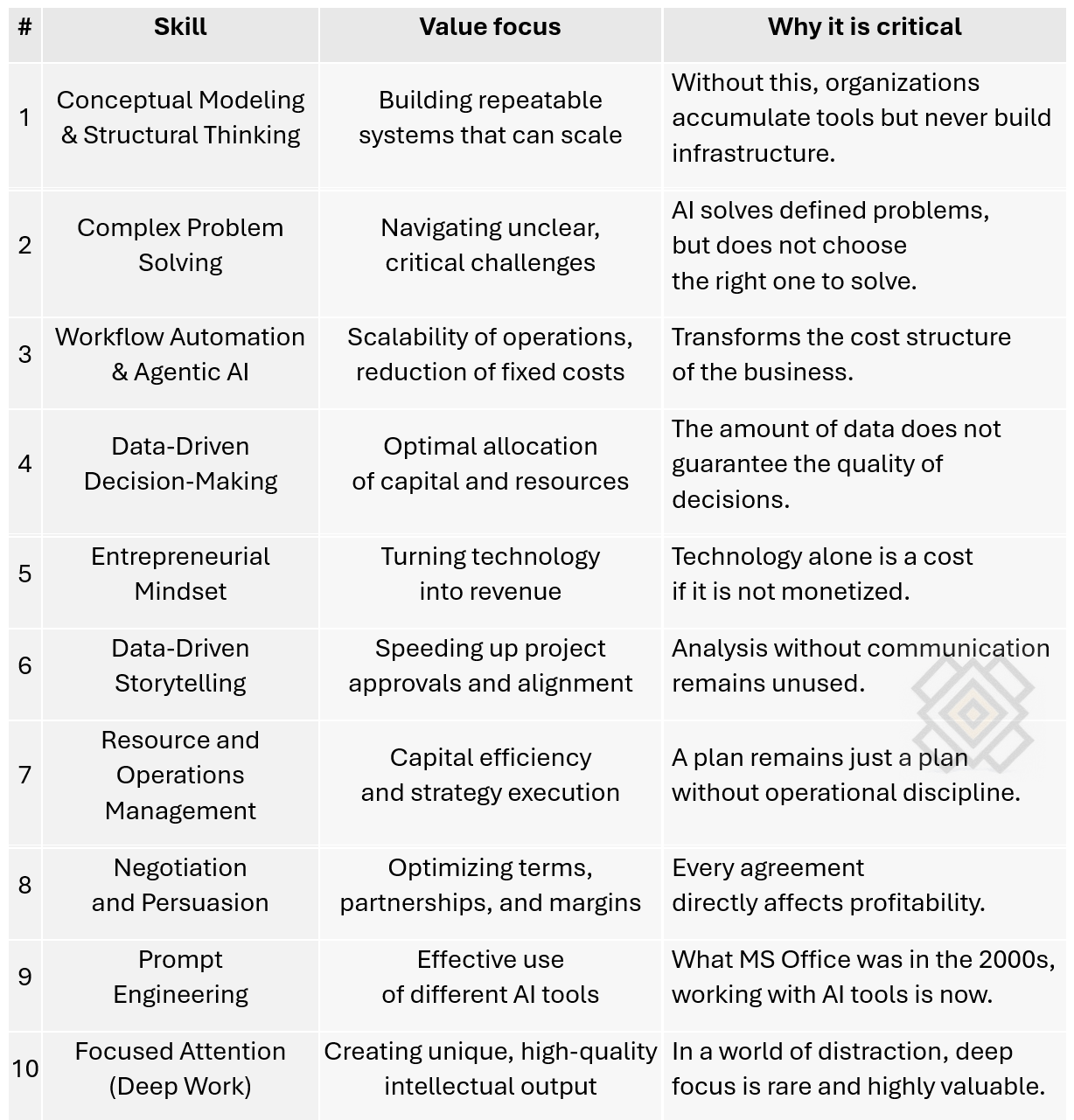
Note: For those interested in the full list of all Top 30 skills that define how to adapt business strategy, re-skilling strategy, and hiring strategy for the coming years — and how to apply them in a specific company context — feel free to get in touch.
5 Things You Can Apply This Month
Regardless of the organization’s level or individual role, the following five actions can be started immediately.
WEEK 1: Map one process
Skill: #1 Conceptual Modeling
Action: Choose one process you perform every day and sketch it on paper — from beginning to end.
Time: 30 minutes
Result: Clear view of where time is wasted and where automation could help.
WEEK 2: One decision based on data
Skill: #4 Data-Driven Decision-Making
Action: Before the next decision, ask: “What data do I have?” instead of “What do I feel?”
Time: 0 minutes (it is a change in mindset, not duration)
Result: Better decisions, fewer “gut feeling” errors.
WEEK 3: Automate one repetitive activity
Skill: #3 Automation
Action: Identify a task you perform 5+ times per week and automate it (Excel macro, Zapier, AI tool, etc.).
Time: 1–2 hours
Result: 2–5 hours saved every week.
WEEK 4: Present with a story, not just numbers
Skill: #6 Data-Driven Storytelling
Action: Design the next report using the format: Problem → Data → Action → Result.
Time: 15 extra minutes
Result: Up to 3x higher chance of approval.
BONUS: Deep Work session
Skill: #10 Focused Attention
Action: Once a day, schedule 90 minutes with no notifications — one task only.
Time: 90 minutes (but more productive than 3–4 hours with constant interruptions)
Result: 2x higher quality of output.
How to apply this at the organizational level
Step 1: Map the current state
Determine which level (1, 2, or 3) the organization is currently operating at.
Assess which of the Top 10 skills are already developed — and where the largest gaps are.
Set quantitative goals, for example: “By the end of Q2, all key Level 1 processes have a documented workflow model and are in an automation pilot phase.”
Segment the business by function (sales, marketing, IT, operations, HR) and map the state of each function.
Step 2: Prioritize
Focus on 2–3 skills with the strongest impact at the current stage.
If the organization is at Level 1: priority = skills #1 + #3
At Level 2: priority = skills #4 + #6
At Level 3: priority = skills #5 + #9
Choose skills that are rare inside the organization but have high value.
Step 3: Embed skills into everyday work
Integrate these skills into onboarding and development plans.
Add application of these skills into promotion criteria (e.g., a new team member contributes to process modeling or automation within the first 90 days).
Create micro-projects where teams develop skills through practice — every 4–6 weeks a team completes one pilot and measures its impact.
Guide communication with the question: “Why are we doing this?” — connect each change to purpose (Level 2) to increase acceptance.
Step 4: Measure progress
Track application, not just training attendance: number of modeled processes, number of decisions based on data, number of active AI workflows.
Measure value: cost savings, productivity gains, additional revenue.
Measure compounding value: impact that grows over time — this is where the compounding effect becomes visible.
Establish a dashboard that tracks status by function, level, and skill.
Conclusion: Organizational intelligence = the synthesis of three levels
Successful organizations by 2030 are not the ones with the most tools — they are the ones that:
Build clear structure (Level 1)
Understand and communicate purpose (Level 2)
Create systems that generate compounding value (Level 3)
Developing the Top 30 skills is not a “checklist” — it is a continuous growth system, designed to scale.
Additional resources
Research sources related to skills 2030:
World Economic Forum – Future of Jobs Report
McKinsey Global Institute
IBM SkillsBuild / Global C-Suite Study
Boston Consulting Group (BCG)
Bessemer Venture Partners (BESS)
PwC, OECD, The Turing Institute
Key concept references:
Compounding value: definitions inspired by sources such as Investopedia and Sage
Deep Work: Cal Newport – Deep Work: Rules for Focused Success in a Distracted World
Agentic AI: system-level AI that can autonomously decide and execute tasks within defined boundaries
Note: The research “Business Architecture 2025-2030“ started October 16, 2025. Contact me for details and personalized insights for you and your organization.