
Practical Philosophy Architecture & AI
A system for clear learning, living, and leadership in the age of acceleration

Philosophy in Practice showed why thinking clearly matters.
Practical Philosophy Architecture shows how to do it.
Practical Philosophy Architecture & AI
(Audio Overview by Notebook LM)
Introduction: From Why to How
In the AI age, we have infinite answers — but no compass.
Philosophy, once seen as abstract, becomes a survival skill: it helps us slow down, think clearly, and make meaningful choices when everything around us accelerates.
Practical Philosophy Architecture (PPA) turns timeless philosophical principles into modern frameworks for clarity, resilience, and adaptability.
It builds on the ideas introduced in the Philosophy in Practice Hub →, where we explore why philosophy matters in the age of AI.
Here, you’ll learn how to use it — through four practical models.
The Simplified 3×3 Philosophy Matrix
- Unified Compass
A map for where philosophy meets practice.
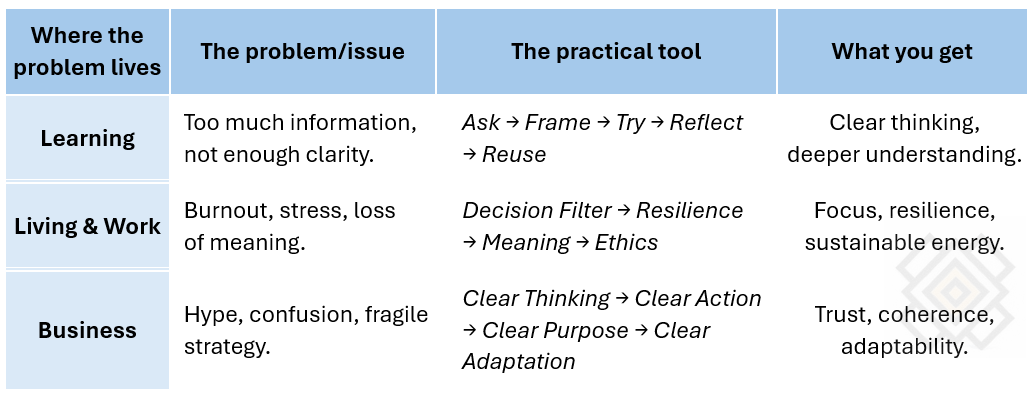
These three levels — Learning, Living, and Business — represent the foundation of practical clarity. The Unified Compass connects them whenever learning, work, and life converge.
The Four Meta-Philosophy Models
How philosophy becomes a practical system — four frameworks for clear thinking, meaningful action, purposeful building, and integrated adaptation.
Each model represents a different way of applying philosophical reasoning —
from how we learn (The Learning Loop), to how we live (Philosophy as Practice), to how we build (The Clarity Compass), and how we unify them (The Unified Compass).
🔹 1. The Learning Model — The Learning Loop
Purpose: To transform information overload into deep, structured understanding.
You’ll learn to:
Ask better questions
Build mental models
Turn knowledge into practical insight
Prompt: Ask → Frame → Try → Reflect → Reuse
Explore Learning Loop →
🔹 2. The Living Model — Philosophy as Practice
Purpose: To act, decide, and live with meaning — even under pressure.
You’ll learn to:
Filter choices that strengthen you
Build resilience
Reconnect action with values
Prompt: Decision Filter → Resilience → Meaning → Ethics
Explore Living Toolbox →
🔹 3. The Business Model — The Clarity Compass
Purpose: To build trust-based, purpose-driven, adaptive organizations.
You’ll learn to:
Think clearly and make data-grounded decisions
Align behavior with principles
Connect culture, purpose, and adaptability
Prompt: Clear Thinking → Clear Action → Clear Purpose → Clear Adaptation
Explore Business Compass →
🔹 4. The Unified Model — The Unified Compass
Purpose: To integrate learning, living, and business clarity into one flow.
You’ll learn to:
Diagnose your challenge (is it a learning, life, or business issue?)
Apply or combine the right model(s) automatically
Create a personal or organizational clarity system
Prompt: Select or combine models dynamically.
Explore Unified Compass →
Meta-Philosophy Models at a Glance
Each model translates philosophy into a usable system — for thinking, acting, building, or integrating.
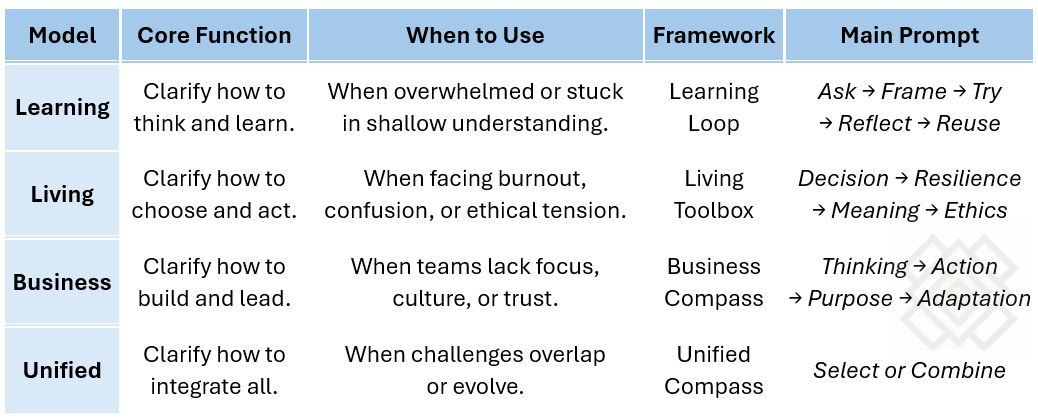
Use this table to identify which model fits your current challenge.
If your situation spans multiple layers — for example, personal focus and team direction — begin with one model and expand through the Unified Compass.
The Purpose of the Architecture
Practical Philosophy Architecture is not about knowing more — it’s about knowing what matters.
It gives you the clarity system to:
Think better – by structuring how you learn.
Live better – by choosing what aligns with meaning.
Lead better – by building ethical, adaptive organizations.
Integrate better – by connecting all three when life and work overlap.
Each model stands on its own — yet together, they form a lifelong architecture of clear thought, meaningful action, and purposeful adaptation.
Philosophy here isn’t abstract — it’s applied clarity for modern complexity.
Ready to explore how these models work together in real life?
← Back to Philosophy in Practice Hub