
The Most Neglected Growth Engine: Why Business Development Defines Competitive Advantage
Most companies still treat business development as “sales with a suit.” Those that don’t quietly build the systems everyone else ends up copying. Extremely important in AI Age.

The Invisible Gap: When “More Sales” Isn’t Growth
Across industries, roughly 70–85% of companies blur the line between Sales and Business Development (BD) — a range echoed across McKinsey’s Organizational Health Index (2023) and Forrester’s Partner Ecosystem Report (2024).
Sales is about revenue now.
BD is about markets later.
When leadership treats BD as “pipeline support,” strategy collapses into quota math. The result:
Reactive growth loops
Misaligned resource allocation
Missed long-term market entry opportunities
Go-to-BD shift: Stop asking “How do we sell more?”
Start asking “Where should we sell next — and with whom?”
A Forrester 2024 survey of 612 B2B firms found that companies distinguishing BD from Sales achieved 15–25% faster entry into new markets, measured by time-to-first-revenue in new segments (2019–2023 sample window).

Business Development ≠ Sales: The Structural Difference
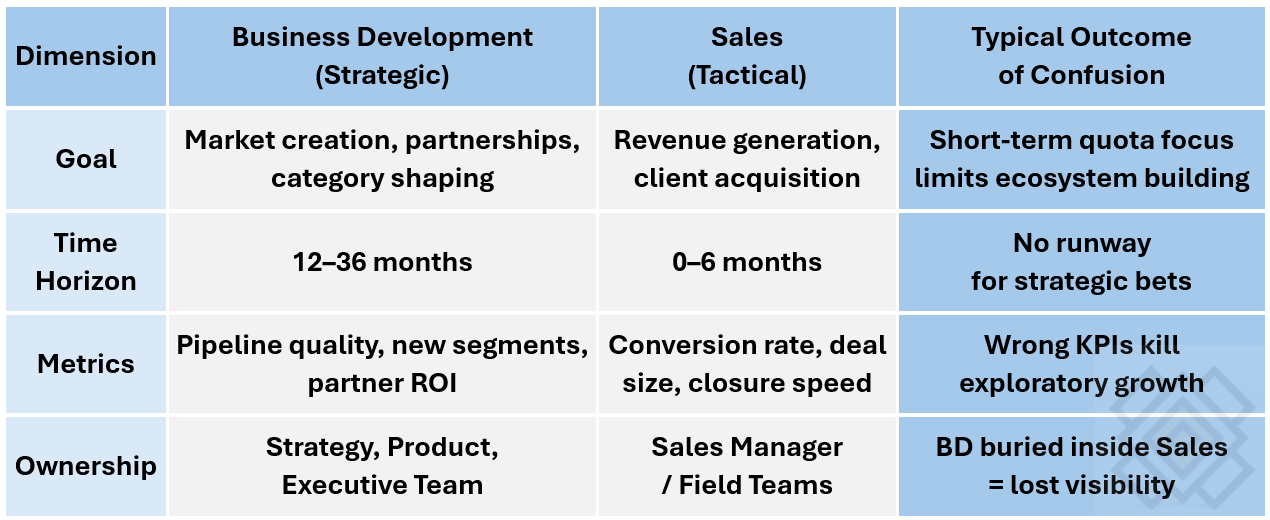
“High-growth organizations distinguish between those who design demand and those who capture it.”
— (McKinsey, 2021, Building Effective BD in Pharma)
A mid-sized manufacturing supplier (~$180M annual revenue) that separated BD and Sales in 2022 saw 18% JV revenue growth within 12 months, driven by co-branded distributor partnerships, not additional hiring.
The Role Confusion Matrix: Evidence of Blurred Boundaries
When everyone owns “growth,” no one really does.
McKinsey (2023) found companies with undefined BD charters experience a 20–30% drop in decision velocity, measured by time between market signal and action.
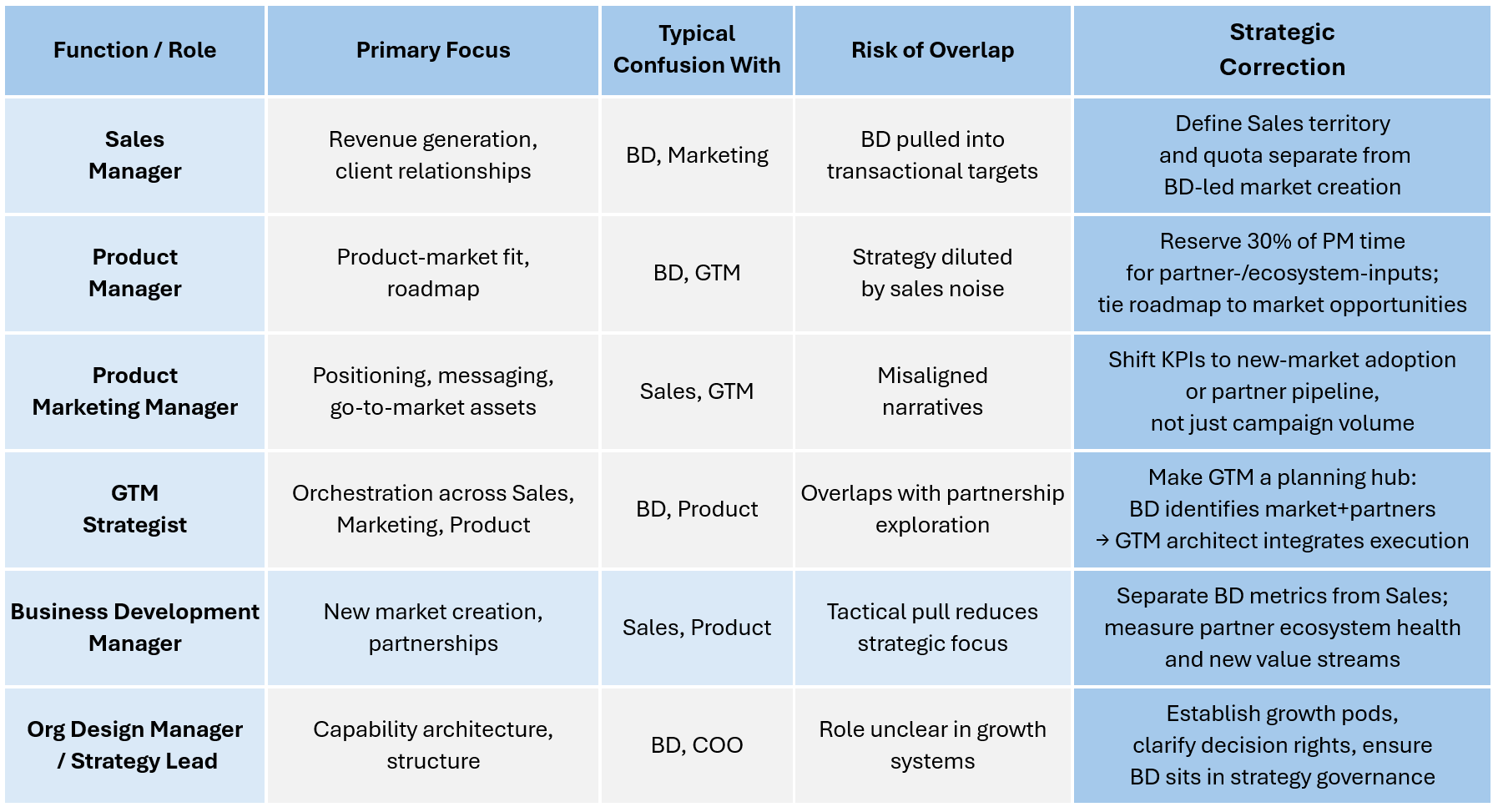
Each column hides real loss: misdirected time, duplicated work, and opportunity decay.
Go-to-BD shift: Role clarity isn’t bureaucracy — it’s revenue discipline.
The Six-Week Business Development Realignment Playbook
A full reorganization isn’t needed. Most firms can re-architect growth alignment within six weeks using existing staff.
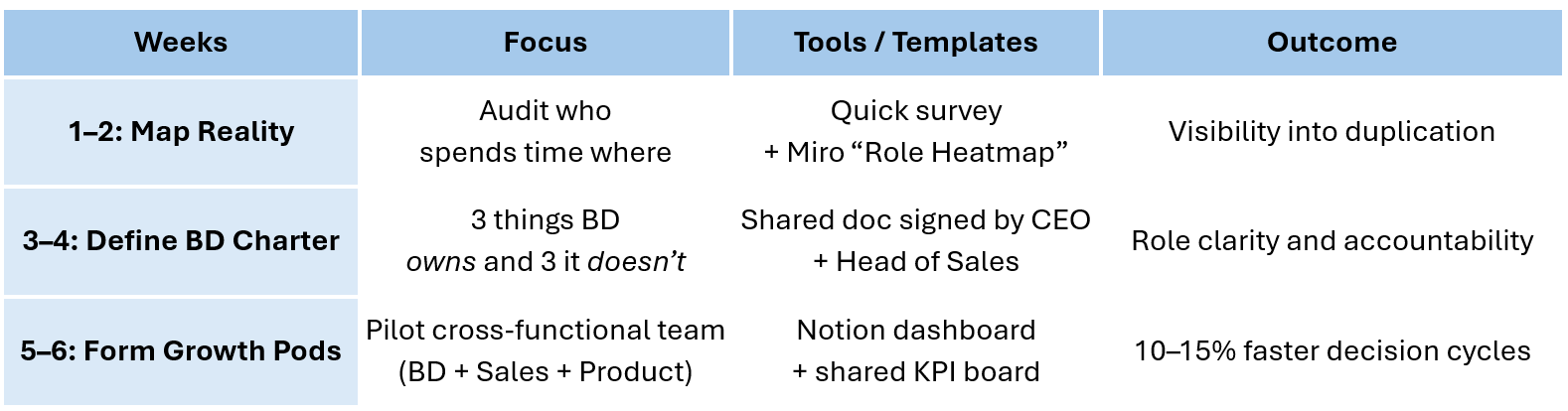
In short: if you dedicate just six weeks to defining where business development starts and sales ends, you’ll unlock faster deals, clearer accountability, and fewer missed opportunities—without hiring anyone new.
Navigating the Transition
Restructuring Business Development and Sales overlap takes both structure and empathy. Keep these four rules simple and visible:
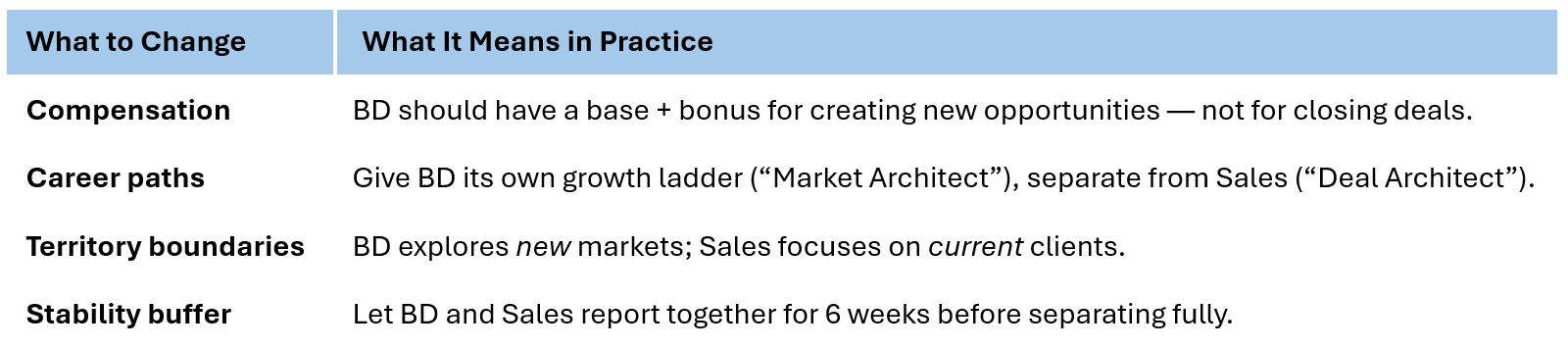
💡 Why this matters: When teams know who builds markets and who sells into them, growth stops competing with itself.
Companies that clarify BD pay models early see ≈ 40 % lower turnover during transition (McKinsey, 2023).
Case Snapshots: How Clarity Turns into Growth
Case 1 — Mid-Market SaaS Platform (~$50M ARR)
In 2023, BD and inbound Sales were separated into distinct charters.
Within 12 months:
Partner-sourced leads grew from 15 → 32 per quarter (+113%)
Average enterprise deal size rose $180K → $220K (+22%)
Sales cycle time shortened by 18%
Case 2 — Industrial Supplier (~$180M revenue)
A 2022 BD Charter tied to corporate strategy generated:
15% higher margin on joint ventures
25% fewer stalled deals (measured via CRM pipeline decay)
Zero headcount increase
“Firms that embed BD into strategic planning achieve 8–10% higher deal value and 20% higher compound growth.”
— (Deloitte, 2023, The Future of Sales and BD)
Context Shapes the Play
SMEs
Even allocating 10% of the founder’s week to “future-market design” drives measurable returns. EY’s SME Scaling Barriers report (2022) found small firms with explicit BD focus achieved 30% faster new-line growth.
Large Enterprises
Governance is key. BD must report to Strategy or the CEO — not Sales — to avoid quota gravity.
Healthcare / Finance
BD acts as a compliance architect, brokering alliances that pass regulatory review (e.g., white-label fintech partnerships).
Capital-Intensive Sectors
BD focuses on multi-year consortiums — think co-developed infrastructure or aerospace contracts.
Professional Services
BD formalizes what “rainmakers” do intuitively — structured referral ecosystems, partner agreements, and speaking-driven client sourcing.
B2C Brands
BD = brand collaboration. Think co-drops, cross-audience events, and creator alliances — partnerships that compound visibility.
When Integration Still Works
Some integration between BD and Sales is healthy — especially early on.
Early-stage startups (<$5M): Founders should wear both hats until patterns emerge.
Transactional SaaS: When customer acquisition is automated, BD may only support enterprise expansion.
Mature, stable markets: Once partnerships are fixed, BD pivots to diversification, not daily sales.
BD separation isn’t dogma — it’s a timing decision. The earlier it’s recognized, the less costly it becomes.
Conclusion — Clarity as an Operating System
Business Development isn’t a department. It’s a strategic architecture that connects intent to market reality.
Companies that separate BD from Sales move faster not because they work harder — but because they decide better.
If your team keeps “fixing sales” but results stay flat, it’s not your reps. It’s your system.
You don’t need another playbook — you need role clarity.
Clarity is not theory. It’s infrastructure. Build it once — and it pays forever.
Start with your Week-1 Role Heatmap this Monday. Clarity compounds.
Further Reading & Research Sources
McKinsey (2023), Organizational Health Is (Still) the Key to Long-Term Performance:
https://www.mckinsey.com/capabilities/people-and-organizational-performance/our-insights/organizational-health-is-still-the-key-to-long-term-performanceMcKinsey (2021), Building Effective BD in Pharma:
https://www.bcg.com/publications/2021/six-ways-to-build-an-effective-pharmaceutical-business-development-strategyMcKinsey (2023), Organizational Health Index (OHI) PDF:
https://www.mckinsey.com/solutions/orgsolutions/overview/organizational-health-indexForrester (2024), The State of Partner Ecosystems in 2025:
https://www.forrester.com/blogs/the-state-of-partner-ecosystems-2025/Deloitte (2024), The Future of Sales and Business Development:
https://www.deloittedigital.com/us/en/insights/research/thrive-in-the-future-of-sales.htmlEY (2022), EY FinTech scale-up handbook
https://www.ey.com/content/dam/ey-unified-site/ey-com/en-uk/insights/banking-capital-markets/documents/ey-fintech-scale-up-handbook-interactive.pdfBCG (2023), Uniting CPG Marketing and Sales for Collaboration and Growth
https://www.bcg.com/publications/2025/uniting-cpg-marketing-and-salesHarvard Business Review, Topic, The Product Management
https://hbr.org/topic/subject/product-management
Hey, great read as always. That McKinsey quote about "designing demand and capturing it" realy hits different, it's such a clever way to frame the strategic problem. It makes total sense why companies struggle when those roles are blurred, it's like mixing up your data input and your model training phase.